Blog Post
New Publication "Beyond Post-Soviet: Layered Legacies & Transformations in Central Asia"
Sep 29, 2021
Researchers from Various Disciplines Discuss their Ongoing Research on the Region
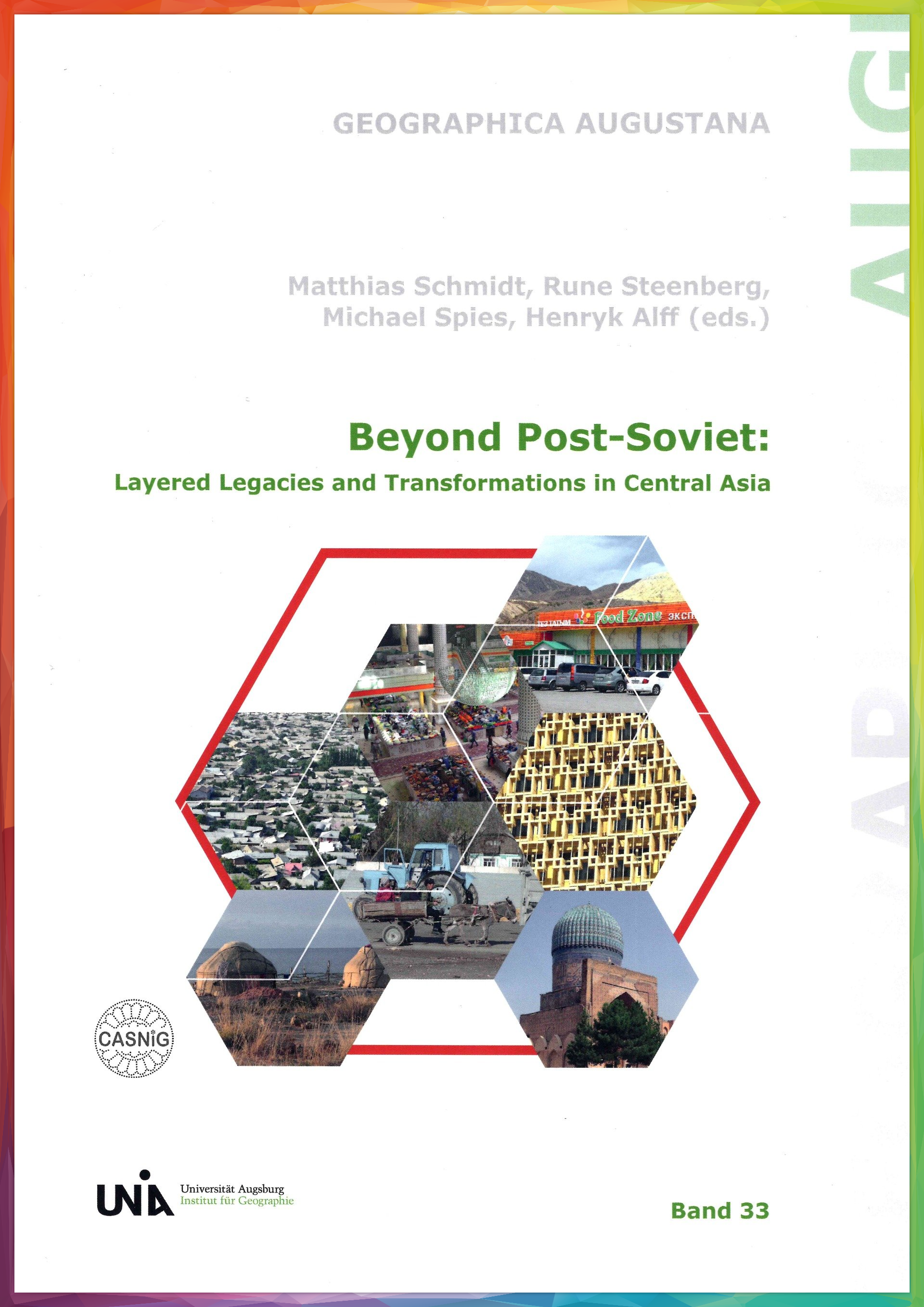
Thirty years after the disssolution of the Soviet Union, the Central Asian republics are still often granted the epithet 'post-Soviet'. While this is technically true, the region has been shaped and differentiated not only by seven decades of Soviet rule, but also by a pre-Soviet feudal and colonial history as well as various more recent phenomena and developments. Thus, each social phenomenon observed in Central Asia today has its own unique combination of elements from the past deriving from "layered legacies" — legacies of different phases that reinforce, interact with or contradict each other in complex ways, and can have very different consequences in local contexts.
This volume examines some of the region's layered lagacies by eclectically zooming in on topics, such as urban planning, water management, agricultural production, communal cooperation, migration patterns, ethnicity, Islam and gender. The overarching question explored across these different examples pertains to the relative relevance and dynamic interaction of these layers of legacies. Are Soviet structures still relevant today? How much was disrupted by the transformation efforts in the 1990s and to what degree are Central Asian republics affected by current global socio-economic and political dynamics today?
The publication outlines results of two workshops that were conducted earlier this year in Augsburg and online from Eberswalde. They served as first annual meetings of the Central Asian Studies Network in Germany (CASNiG), an open network of Central Asia researchers, to exchange ideas, concepts and findings, and promote collaboration, mutual support and solidarity. This volume presents selected papers based on contributions from the two workshops, addressing contemporary issues and layered legacies in Central Asia. It was edited by one of the TRANSECT advisors, Matthias Schmidt from Augsburg University, Rune Steenberg and TRANSECT members Michael Spies and Henryk Alff. Other contributors are Gukzat Baialieva, Ottawia Cima, Andrei Dörre, Zarina Mukanova, Tabea Rohner, Jenniver Sehring, Wladimir Sgibnev, Martin Welp, and Katerina Zäch.
This volume examines some of the region's layered lagacies by eclectically zooming in on topics, such as urban planning, water management, agricultural production, communal cooperation, migration patterns, ethnicity, Islam and gender. The overarching question explored across these different examples pertains to the relative relevance and dynamic interaction of these layers of legacies. Are Soviet structures still relevant today? How much was disrupted by the transformation efforts in the 1990s and to what degree are Central Asian republics affected by current global socio-economic and political dynamics today?
The publication outlines results of two workshops that were conducted earlier this year in Augsburg and online from Eberswalde. They served as first annual meetings of the Central Asian Studies Network in Germany (CASNiG), an open network of Central Asia researchers, to exchange ideas, concepts and findings, and promote collaboration, mutual support and solidarity. This volume presents selected papers based on contributions from the two workshops, addressing contemporary issues and layered legacies in Central Asia. It was edited by one of the TRANSECT advisors, Matthias Schmidt from Augsburg University, Rune Steenberg and TRANSECT members Michael Spies and Henryk Alff. Other contributors are Gukzat Baialieva, Ottawia Cima, Andrei Dörre, Zarina Mukanova, Tabea Rohner, Jenniver Sehring, Wladimir Sgibnev, Martin Welp, and Katerina Zäch.
Reference:
M. Schmidt, R. Steenberg, M. Spies & H. Alff (eds.) (2021): Beyond Post-Soviet: Layered Legacies and Transformations in Central Asia. (Geographica Augustana 33). Institut für Geographie, Universität Augsburg. ISBN 978-3-948283-05-6.
A free copy of the journal is available here: